
№ 000219 AUGUST 2026DEATHURAL MOUNTAINS, USSR
The Dyatlov Pass Incident
Nine Hikers, One Mountain, No Explanation
Unsolved since 1959In February 1959, nine experienced hikers cut their way out of their own tent, from the inside, and walked into a Siberian night forty degrees below zero. A 2021 physics paper finally explained how. It still can't explain why.
What We Know
Igor Dyatlov was twenty-three and had done this before. On January 27, 1959, he set out toward Gora Otorten with nine others, most of them students or recent graduates of the Ural Polytechnic Institute, on a ski expedition rated for the harshest Soviet mountaineering grade. One of the ten, Yuri Yudin, fell ill on the second day and turned back. He never saw the other nine again.
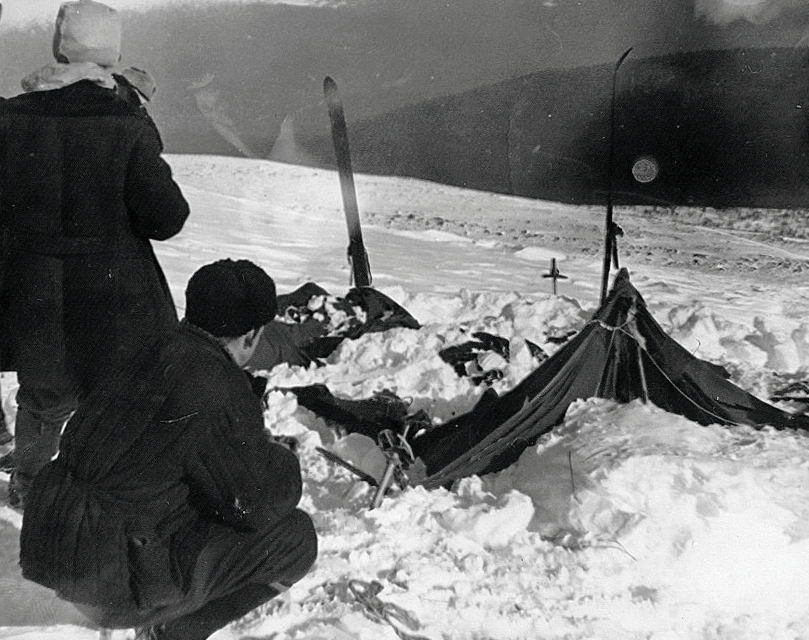
On February 1, the group pitched their tent on the slope of a mountain the local Mansi people called Kholat Syakhl, “Dead Mountain.” Sometime that night, all nine cut their way out of the tent from the inside, several in socks or a single boot, and moved downhill toward the treeline more than a kilometer away. Search parties found the tent three weeks later, still staked, its canvas slashed outward. The bodies took months to recover. Some had died of hypothermia. Others had injuries more severe than a fall could explain, chest and skull trauma with no matching external wounds, the kind blunt-force impact leaves. The Soviet investigation closed within three months, attributing the deaths to an unnamed “compelling natural force,” and sealed the file.
The Roadblock
Every theory has to explain the same strange combination: why nine trained, well-equipped hikers abandoned a working tent, in the dark, in cold that kills exposed skin in minutes, without stopping to grab boots or coats. For sixty years, the leading physical explanation, an avalanche, seemed to fail on its own evidence. The slope was measured at roughly 16 degrees, well under the angle avalanche researchers normally consider dangerous, and rescuers found none of the usual avalanche debris at the site. That absence was treated for decades as proof the avalanche theory was dead. It wasn’t proof of that. It was proof nobody had yet modeled the right kind of avalanche.
Best Guesses
Slab avalanche
In 2021, engineers at ETH Zurich and EPFL Lausanne built a physics model showing how a small, delayed slab release could occur even on that shallow a slope, triggered by the group’s own tent cut into the snow, wind-driven snow accumulation above it, and a specific release mechanism that doesn’t leave the debris pattern of a textbook avalanche. The model’s injury predictions matched the autopsy reports closely enough that follow-up field expeditions in 2022 and 2023 went looking for supporting terrain nearby and found it: comparable slopes within a few kilometers capable of exactly this kind of release. It’s the only theory with a peer-reviewed mechanism and physical field validation behind it. It still doesn’t fully explain why survivors moved so far from camp instead of sheltering closer to the damaged tent.
Katabatic panic
An older hypothesis holds that fast-moving wind over the ridge’s specific shape generated infrasound, low-frequency sound below human hearing that some research has linked to feelings of dread and disorientation. It would help explain sudden, irrational flight from a shelter that wasn’t obviously destroyed. There’s no way to test for infrasound forty years after the fact, and the theory has never been tied to the group’s actual injuries.
Weapons-test injury
Start with what’s true: the region did carry restricted military activity in that era, and the Soviet investigation was closed fast and sealed, which is precisely the behavior that breeds this kind of theory. What’s never materialized, across decades of declassifications, is a document, a witness, or a piece of physical evidence tying any specific test to this specific night. The theory survives on the shape of the secrecy rather than on anything inside it.
Attacked on the mountain
No tracks. No signs of struggle beyond what nine people fleeing a tent would leave on their own. No plausible second party within reach of that slope in February. This is the least evidenced of the four by a wide margin, and it persists mainly because a violent explanation feels proportionate to how strange the scene was.
The Verdict
Yuri Yudin turned back on the second day and outlived his nine friends by fifty-four years. He helped identify their belongings when the bodies came down. He spent decades pressing for the case to be reopened, and he died in April 2013 still unpersuaded by every explanation anyone had brought him.
The avalanche work arrived too late for him and likely wouldn’t have moved him regardless. That’s no argument against the physics; the model does precisely what the old objections insisted no model could. It’s worth saying anyway, because the people closest to this were never really asking for a mechanism. They wanted to know what happened to their friends on that mountain, which is a different question, and the snow has never given that one up.
Where do you stand?
That’s one. There’s another every morning at 6 a.m. local time.
Share where you stand
The Rabbit Hole
- Communications Earth & Environment: the original 2021 avalanche mechanism paperthe physics, in full
- Communications Earth & Environment: the 2022 field-validation follow-upwhat the return expeditions actually found
- Dyatlov Foundation case archiveprimary documents, autopsy summaries, and search records